
We help Sydney homeowners understand underpinning and act fast to protect a house with cracked walls or sloping floors. With 20+ years’ experience, we are fully licensed and insured. We use council‑compliant methods and offer honest assessments with minimal disruption.
Our team explains how foundation work safely redistributes loads and restores structural integrity. Common causes include reactive soil, nearby excavations and age‑worn foundations. We assess the site, recommend a tailored process, and coordinate engineering reports and approvals.
Services include concrete underpinning, screw piles, resin injection where suitable, wall crack repairs, subfloor ventilation and retaining wall support. We provide free no‑obligation structural assessments, transparent fixed‑price quotes and warranty documentation.
To move forward, call 1300 970 930 or speak to Chris to book a site inspection. You can also email photos for a fast preliminary review and clear, practical advice.
Key Takeaways
- We protect your home by reinforcing weak foundations with proven techniques.
- Assessments are free, council‑compliant and engineered for lasting results.
- We handle reports, approvals and construction to reduce your stress.
- Options include concrete underpinning, screw piles and resin injection.
- Contact us: Call 1300 970 930, speak to Chris or email photos for quick advice.
Underpinning explained: how foundations are strengthened to protect your home
Foundations that shift need clear solutions to protect a Sydney home’s safety and value. We explain the main repair types simply, so you can see which method suits your property.
Existing foundation and why it moves
Your existing foundation includes footings, perimeter walls and the slab. Movement often comes from reactive soils, nearby excavation, erosion or extra loads from extensions.
Underpinning versus footing repairs and slab stabilisation
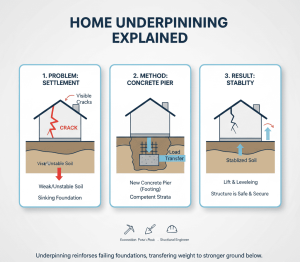
Traditional concrete underpinning enlarges footings through excavation and new concrete to redistribute weight for long-term performance.
| Repair type | Best for | Key feature |
|---|---|---|
| Concrete underpinning | Perimeter footings, major settlement | Robust load redistribution |
| Screw piles | Deeper stable soils, relevel work | Steel piers with concrete footings |
| Resin injection | Localised slab lift | Fast, low‑mess ground densification |
- Footing repairs suit minor, local damage.
- Slab stabilisation targets isolated slab issues, not perimeter support.
- We select the right method based on soil profile, access and building type.
We promise honest assessments. If monitoring or moisture control is the best first step, we’ll document why and outline the paperwork you’ll receive for insurers and conveyancers.
What is underpinning
We use engineered supports to move load from weak soil to deeper, firmer conditions beneath a house.
Plain-English definition and core purpose
Underpinning means building new support beneath an existing foundation so a house rests on more stable ground. This can involve deeper piers or wider footings beside or under the current footing.
When it is an appropriate solution
It suits ongoing subsidence or settlement that will not self‑correct, such as uncontrolled fill or shallow founding. If movement stems from clay heave, we often recommend moisture control, tree management and ventilation before any structural work.
- Engineers investigate with photos, floor levels and risk assessments.
- They provide written advice and a fixed‑price scope for the work.
- Triggers include stair‑step cracking, jammed doors and visible footing drops.
| Issue | When underpinning helps | Alternative first step |
|---|---|---|
| Persistent differential settlement | Yes — transfer load to deeper soil | Engineering investigation and monitoring |
| Shallow founding on loose fill | Yes — deepen or widen footings | Soil compaction if access allows |
| Clay moisture heave | Not always — structural work alone may not fix | Drainage, moisture management and tree works |
Why foundations fail in Sydney: soils, water and load factors
Local soil behaviour and changing weather often drive foundation problems across Sydney. We explain the main causes calmly and show how to move to a lasting fix.
Reactive clay, droughts, floods and trees
Reactive clay shrinks in drought and swells after heavy rain. This seasonal change causes movement and visible cracking in walls and slabs.
Large trees intensify shrinkage through transpiration. Routine moisture control around the house helps reduce cycles of shrink and swell.
Uncompacted fill, erosion and nearby works
Poorly compacted fill settles over time and cannot reliably support a building load.
Erosion from leaks or bad drainage removes ground under footings. Nearby excavation or slope creep can destabilise edges and produce uneven settlement.
Added weight and changing loads
Extensions or a second storey increase weight on legacy foundation designs. Older footings may not transfer extra load to firm ground.
- We test soil depth to sound strata and document findings.
- We prioritise moisture control, plumbing fixes and drainage before major works.
- We offer engineered plans for deeper supports or temporary works where needed.
Signs your house may need underpinning
Not all cracks mean danger, but some patterns show active settlement that requires urgent review. We help you spot practical signs and decide when to call for an assessment.
Cracks in walls, brickwork and slabs: normal versus worrying
Hairline cracks in plaster often come from minor drying and are usually cosmetic.
Worrying cracks widen, lengthen or reappear after repairs. Cracks that step through brick mortar or run from window corners suggest subsidence and need inspection.
Sloping floors, gaps at ceilings, sticking doors and windows
Uneven or sloping floors, and doors or windows that stick, point to uneven support under the slab or perimeter.
Gaps at cornices or between ceilings and walls that persist across seasons are red flags for ongoing movement.
Visible settlement or leaning and misaligned frames
External step cracking in brickwork or mortar separation shows differential settlement at the foundation edge.
Document changes with photos and dates. Contact us early for a free assessment and a fixed‑price plan. We control movement first, then restore walls and finishes to protect value and safety.
- Hairline cracks vs progressive cracks: note width and recurrence.
- Cracks from windows and doors often mean perimeter movement.
- Misaligned skirting, architraves and sloping floors indicate uneven support.
- Persistent gaps at cornices are grounds for professional review.
Underpinning methods compared: concrete, screw piles and resin injection
Different foundation methods suit different soils, access limits and settlement patterns. We compare the three main types we offer so you can see trade‑offs in cost, access and finish.
Concrete underpinning
Concrete underpinning uses excavation beside or under existing footings. New concrete footings widen or deepen support to redistribute weight.
Best for: significant settlement and long‑term stability. Requires more access and reinstatement but performs well for major issues.
Screw piling
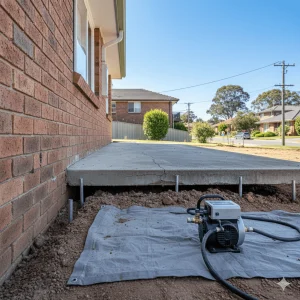
Screw piles use steel piers set to deeper bearing ground with concrete pads where needed. Excavation for pile heads is required.
Best for: sites needing deeper bearing strata and controlled re‑levelling. Less concrete in the ground and predictable load transfer.
Resin injection
Resin injection is a fast, low‑mess method to lift slabs and densify ground. It needs testing to confirm soil suitability.
Best for: localised slab lifts and tight access. Not suitable for every ground type or major perimeter footing failure.
- We recommend the method that suits the house, soil and access.
- All work is engineered, council‑compliant and fully documented.
| Method | Suitability | Access & disruption | Typical timeline |
|---|---|---|---|
| Concrete underpinning | Major settlement, perimeter footings | High — excavation, reinstatement | Weeks to complete |
| Screw piling | Deeper bearing strata, re‑levelling | Moderate — piling gear, small excavations | Days to weeks |
| Resin injection | Local slab lift, ground densification | Low — minimal mess, quick access | Hours to days |
The underpinning process step‑by‑step
A staged, engineer‑led approach keeps your building safe and reduces disruption at every step. We follow a council‑compliant workflow so you and your property are protected from start to finish.
Engineering assessment and site testing
We begin with a structural engineer inspection. They record damage, take floor levels and review past soil reports.
New geotechnical tests usually reach 6–8 m with moisture readings every 500 mm to map seasonal soil conditions.
Design, approvals and construction planning
The engineer sets underpin locations, spacing and depths for the required footing or pier layout.
We obtain building approval, protect services and plan staged excavation to minimise household impact.
Construction, jacking and quality assurance
The contractor stages excavation, places steel and pours concrete with engineer inspections at key hold points.
Jacking follows after concrete cures. Final levels and QA documents are recorded for your files.
- Timeline guide: ~10 underpins in about two weeks; whole‑house programs around a month.
- We prioritise compliance, safety and clear communication at each stage.
| Stage | Typical time | Key check |
|---|---|---|
| Assessment & testing | Days | Engineer report, soil profile |
| Construction & pours | Weeks | Inspections before concrete |
| Jacking & final QA | Days | Recorded levels, certification |
We compile QA documents, certifications and warranties so you have full proof of compliance and restored foundation integrity.
Costs, risks and disruption: what Sydney homeowners should expect
Budgeting for foundation repairs starts with a clear assessment of damage and site access.
Key cost drivers include the extent of damage, the chosen method, tight access and the house footprint. We explain these factors so you can compare options and get realistic pricing.
On‑site impacts and how we limit disruption
Work creates noise and needs clear access. We protect finishes and keep safe walkways for your family.
Scheduling considers weather and site constraints to reduce delays and extra time on site.
Insurance, certification and peace of mind
Insurers often exclude gradual subsidence. Sudden events like storms or floods may be covered.
We supply engineer reports, compliance certificates and fixed‑price quotes with inclusions and contingencies.
Quick cost comparison
| Method | Typical cost level | Disruption | Typical time |
|---|---|---|---|
| Resin injection | Lower | Low | Hours–days |
| Screw piles | Medium | Moderate | Days–weeks |
| Concrete underpinning | Higher | High | Weeks |
Practical advice: clear the site, protect valuables and allow contractor access. Call us for a fixed quote and honest advice tailored to your property, soil and foundation problems.
Alternatives and complementary solutions to improve structural integrity
Long-term stability comes from combining drainage upgrades with targeted repairs, not only heavy foundation work.
We start with soil moisture control to reduce seasonal movement. Well‑designed drainage and planters that divert water relieve pressure on footings and nearby ground.
Soil moisture management, drainage and subfloor ventilation
Improving site drainage lowers the risk of swelling and shrinkage in reactive soil. This helps protect floors and foundations.
Subfloor ventilation reduces humidity beneath timber floors. It prevents rot and keeps timber stumps stable.
Wall crack repairs, flexible joints and retaining wall support
We use flexible sealants and movement joints at cracks to allow minor movement without reappearing damage. That preserves internal finishes.
Where slopes add lateral load, retaining wall support may be needed. Steel anchors, reinforced footings or tiebacks stabilise the ground and protect the building.
We repair cracks and finishes after stabilisation. That restores appearance and value once the ground and structure are secure.
- Control soil moisture and improve surface drainage to reduce future cracking.
- Install subfloor ventilation and adjustable stumps to protect timber floors.
- Use flexible joints and proven repair materials for walls and ceilings.
- Provide retaining wall support where slope pressures affect the property.
- Tailor each solution to your house and local ground conditions.
| Issue | Complementary solution | Benefit |
|---|---|---|
| Seasonal soil movement | Improved drainage and moisture stabilisation | Reduces swelling/shrink cycles, protects floors |
| High subfloor humidity | Subfloor ventilation and adjustable stumps | Prevents timber decay, maintains level floors |
| Minor wall cracks | Flexible sealants and movement joints | Stops repeat cracking and preserves finishes |
| Slope pressure on foundations | Retaining wall reinforcement or tiebacks | Stabilises ground and protects structure |
For a tailored program that combines these measures with engineered repairs, visit our solutions page or contact us for an assessment.
Safety, compliance and documentation: doing it right in NSW
Sydney building rules require clear documentation and certified drawings before any foundation work starts. We follow those rules so your home meets council standards and retains market value.

Licensed trades, insurance and engineer reports
We confirm our licences and public liability insurance before work begins. Our team has a 20+ year NSW track record.
Engineers supply drawings and soil tests. Excavation hold points are inspected before concrete placement to protect structural integrity.
Council approvals and transparent pricing
Building approval is required for any foundation change. We coordinate certifier sign‑off and lodge plans with council when needed.
We provide fixed‑price quotes that list inclusions, contingencies and approvals so you get clear, reliable advice.
- Site inspections and documented hold points during construction.
- Complete engineer reports, soil testing and certifier paperwork.
- Final QA, compliance certificates and warranties for your files or future sale.
- Proactive communication at every stage of the process and construction.
| Item | What we provide | Benefit |
|---|---|---|
| Licences & insurance | Trades licence, public liability, professional indemnity | Legal compliance and homeowner protection |
| Engineering documentation | Drawings, soil tests, staged inspection points | Assures foundation integrity and council acceptance |
| Approvals & certifier sign‑off | DA/CC where needed, certifier inspections, final compliance | Clears construction risk and supports future transactions |
| Quotation & reporting | Fixed‑price quote, progress reports, QA pack | Cost certainty and complete records for insurance or sale |
Why choose Underpinning Sydney
Choose a team that pairs deep technical skill with care for your home and family.
We bring 20+ years stabilising Sydney homes with engineered, council‑compliant solutions. Our approach combines clear engineering, trade experience and minimal disruption to daily life.
20+ years’ experience, honest assessments and minimal disruption
We offer honest assessments that focus on safety and value. We avoid upselling and explain the risks and benefits of each option in plain language.
Services: concrete underpinning, resin injection, screw piling and more
Our services include concrete underpinning and screw piles with concrete footings. Where suitable, we deliver resin injection for localised lifts and densification.
We also repair wall cracks, re‑level floors, install subfloor ventilation and provide retaining wall support.
Free no‑obligation assessments and engineering report coordination
We coordinate engineering reports, approvals and hold‑point inspections so one accountable team manages your project from assessment to completion.
- Free no‑obligation assessment and a transparent fixed‑price quote.
- Engineered plans, council compliance and full QA documentation.
- Minimal household disruption and respectful site management.
Take action today: Call 1300 970 930, speak to Chris, book a site inspection or email photos for a quick preliminary review.
Conclusion
A clear, engineered plan turns uncertainty about soil and footings into a practical repair pathway.
If you see widening cracks, sticking windows or uneven floors you may need underpinning to stop subsidence and further movement.
We confirm causes with deep soil testing and an engineer’s design. Then we choose the right type — concrete underpins, screw piles or resin injection where conditions suit.
We manage the full process from approvals to staged jacking, construction and QA so your foundation and footings are stabilised and documented for insurance and sale.
Your next step is simple and obligation‑free: call 1300 970 930, speak to Chris, book an inspection or email photos for a prompt assessment.