
We restore your home’s foundation with clear, council‑compliant solutions. If you see cracked walls, uneven floors or sticking doors, we assess the structure quickly and offer a fixed, transparent quote so you can decide with confidence.
We are Underpinning Sydney — structural preservation specialists with 20+ years’ experience. Our licensed team delivers concrete underpinning, resin injection, screw piling and targeted repairs to protect foundations and maintain property value.
Safety and minimal disruption guide our work. We coordinate engineering reports, council approvals and clear timelines. Most residential jobs finish fast and many do not require you to vacate. Call 1300 970 930 to speak to Chris, book an inspection, or email photos for a preliminary assessment.
Key Takeaways
- Free no‑obligation assessment and transparent fixed‑price quote before any work starts.
- Licensed team coordinates engineering reports and council‑compliant methods.
- We recommend the right method, not the most expensive option.
- Typical works range from hours for resin solutions to days or weeks for traditional underpinning.
- We prioritise safety, minimal disruption and documentation for insurers and lenders.
Structural preservation specialists for Western Sydney homes
When a home’s foundation shows movement, our team gives steady, engineering-led advice and clear next steps.
We speak plainly to reduce stress. Our process follows a clear sequence: initial contact, on-site inspection, detailed quotation, acceptance, scheduled work and tidy completion. This ensures safety, compliance and minimal disruption to your home.
Calm, engineering-led guidance when foundations move
We assess your house with instruments, levels and visual checks to quantify movement. Where required, we arrange an independent engineering report and coordinate council documentation.
We explain all options, including monitoring if that is safest right now. Our licensed team manages permits, timings and safe work methods so you do not have to juggle contractors.
Free no‑obligation assessments and fixed‑price quotes
We offer free, no‑obligation assessments and transparent fixed‑price quotes. Fixed pricing removes surprises and sets clear expectations for scope, inclusions and exclusions.
- Measured advice from engineers and supervisors.
- Independent engineering reports coordinated by our team.
- Most homeowners remain in their house while compliant work proceeds.
| Stage | What we do | Benefit to you |
|---|---|---|
| Inspection | Instruments, levels, visual checks | Accurate assessment of foundation movement |
| Quotation | Fixed‑price proposal with scope | No cost surprises; clear inclusions |
| Delivery | Licensed team, permits, safe methods | Compliant work with minimal disruption |
| Completion | Clean‑up and certification | Documented outcome for insurers and lenders |
Recognising foundation movement in your house
Spotting early signs protects your home and saves cost. You can often see small clues before a problem becomes serious. We explain clear, practical signs to watch and what to do next.
Cracks, sticking doors and uneven floors to watch for
Look for diagonal cracks near window heads and door frames. These often reflect differential foundation settlement and may indicate subsidence.
Doors that rub or won’t latch, and times when doors windows stick, show racking from movement. Windows that bind or windows stick with seasonal change can signal problems under the slab or footings.
Note uneven floors, soft spots or sudden slope in floors. Gaps between walls and ceilings or skirting pulling away often follow localised movement.
- Hairline cracks can be cosmetic; widening cracks usually point to deeper issues.
- External stepping cracks in bricks and internal plaster fissures are common walls indicators.
- Photograph any changes and report new or growing signs quickly.
| Sign | What to look for | Likely cause | Immediate action |
|---|---|---|---|
| Diagonal cracks | Near windows and door frames | Differential foundation movement | Photograph and book an assessment |
| Sticking doors | Door rubs or won’t latch | Racking from settlement | Note times and call for inspection |
| Uneven floors | Slopes or soft spots | Footing movement or soil change | Avoid heavy loads; seek early advice |
| Gaps at skirting | Skirting pulls from wall | Localised movement | Document growth and contact us |
Early assessment is safer and cheaper. If you are unsure, call 1300 970 930 for a free preliminary assessment and clear next steps.
Why Western Sydney properties subside
Seasonal wet‑dry cycles in local soils are a common cause of progressive settlement at footings. Reactive clay soils shrink in dry spells and swell after rain. This changes support under the foundation and drives movement.

Reactive clay soils, tree roots and moisture changes
Clay soils expand and contract with moisture. Footings lose uniform support when soil volume changes. That leads to differential settlement and visible damage to walls and floors.
Tree roots can draw moisture from soil near footings. Roots cause local drying and worsen uneven settlement at foundation edges.
Drainage issues, leaking services and nearby excavation
Poor drainage, broken stormwater lines and leaking plumbing add water to soil. Extra moisture causes swelling and may hide voids that later collapse.
Nearby excavation or poorly compacted infill reduces lateral support. This can speed subsidence and create new movement zones under your property.
- Reactive clay cycles drive repeated movement.
- Tree roots change moisture and cause local settlement.
- Leaks and poor grading worsen soil instability.
| Cause | Effect on soil | Impact on foundation |
|---|---|---|
| Reactive clay soils | Shrink/swell with moisture | Uneven footing support; cracking |
| Tree roots | Soil desiccation near footings | Localised settlement at edges |
| Leaking services & poor drainage | Soil saturation and consolidation | Swelling, then settlement and voids |
Early action helps. We assess moisture pathways, garden layout and pavement falls to design safe, compliant remediation that limits further damage. Book a site assessment to identify root causes and plan durable solutions.
Underpinning and foundation repair methods we recommend
Choose the right repair method to match soil risk, access and budget for lasting outcomes. We base every choice on engineering data, site access and the least disruptive path to permanent bearing capacity.
Concrete underpinning for long-term bearing capacity
Concrete works extend or enlarge footings to reach competent soil. This gives durable bearing and verifiable capacity.
Traditional concrete methods suit large loads and where deep, stable support is needed. Timelines vary from days to weeks depending on scope.
Resin injection for fast, low‑disruption ground improvement
Resin injection compacts soil and can re-level slabs quickly. Many residential stabilisations finish within hours with small drill holes and little excavation.
Multiple-depth injection (≈0.8–6.5 m) targets problem layers shown in reports. This reduces downtime and lets you return to normal use fast.
Screw piling where deeper, stable strata is required
Screw piles transfer loads to deeper, stable strata. They are ideal near fills, services or where confined access rules out heavy excavation.
This method provides immediate load path and is efficient for buildings needing deeper support without long disruptions.
When to combine methods for complex structures
Mixed soil profiles or irregular building geometry often need combination designs. We stage works to protect services and maintain safe support to the superstructure.
- Concrete underpinning — durable bearing to competent soil.
- Resin injection — fast, minimal excavation, re‑levelling.
- Screw piling — deeper load transfer where needed.
- Combination designs add resilience for complex problems.
| Method | Best for | Typical duration |
|---|---|---|
| Concrete underpinning | Heavy loads; verified bearing | Days to weeks |
| Resin injection | Residential re‑levelling; tight access | Hours |
| Screw piling | Fill, services nearby, deep support | Days |
We select the process from engineering reports, not a one‑size‑fits‑all pitch. Our building documentation includes calculations, drawings and site ITPs. You receive certification and photos of completed foundation repairs for your property.
If you want to learn more about the technical basis and compliance, read our guide on what is underpinning.
Beyond the footing: complete structural remediation
A stable foundation is just the start; long‑term protection needs full structural care. We stabilise the foundation first, then complete walls and cracks repairs that last. This whole‑of‑structure approach prevents repeat movement and protects your property value.
Wall crack repairs and re‑levelling that last
We stitch cracks, replace damaged sections and match finishes so walls look and perform as intended. Re‑levelling corrects floor variances and aligns joinery once footing support is restored.
Subfloor ventilation to manage moisture in clay soils
Where soil moisture drives movement, improving drainage and airflow reduces ongoing effects. Subfloor ventilation and drainage upgrades help manage damp and cut future risk.
Retaining wall support to prevent lateral movement
We assess retaining structures and design supports to resist lateral loads and surcharge. Many solutions avoid heavy excavation by drilling small holes and backfilling with non‑shrink grout.
- Foundation stabilised first, then wall and cracks repairs.
- Re‑levelling using resin injection or densification where suitable.
- Subfloor ventilation and drainage upgrades to manage soil moisture.
- Designed retaining support to prevent lateral movement.
- Engineer‑reviewed specifications, staged finishing and dust control.
- Completion pack with photos and maintenance notes for your home.
| Service | Benefit | Typical method |
|---|---|---|
| Crack stitching & repair | Durable wall repair and matched finish | Stitch bars, epoxy and render |
| Re‑levelling floors | Aligned floors and joinery; quick return to use | Resin injection or grout densification |
| Subfloor ventilation | Reduced moisture cycles in clay soil | Vents, drainage channels and barriers |
We coordinate sequencing, protection and communication throughout works. For financing options and further details, see our financing options.
Our compliant process for peace of mind today
Start the process today with a quick photo triage or a booked site inspection to begin a clear, managed repair plan.
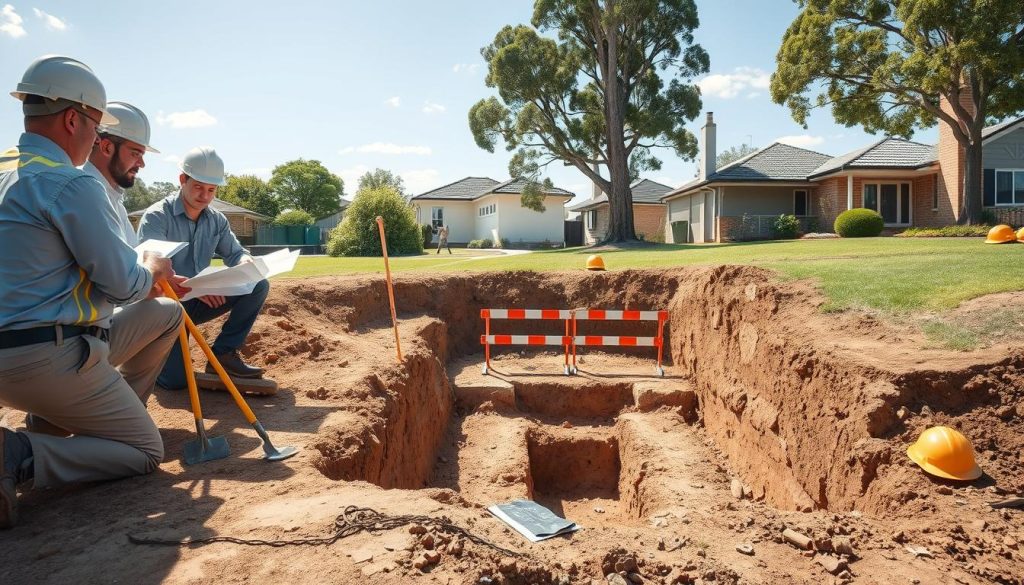
Book a site inspection, email photos for a preliminary assessment
Send photos and basic notes and our team gives a prompt preliminary assessment. This lets us triage urgency and advise next steps quickly.
You can also book an on‑site inspection. A site meeting captures levels, maps defects and records the building and foundation condition for the report.
Engineering report coordination and council‑compliant methodology
We coordinate the engineering report and prepare a council‑compliant methodology when required. Your quote outlines scope, inclusions and sequencing.
Council permits are lodged and managed by us so you do not need to chase approvals during the job.
Licensed, insured delivery with minimal disruption to your home life
Licensed supervisors oversee critical stages and sign off hold points. Temporary supports and service protection keep the building safe at all times.
We schedule work to limit disruption. Many resin projects finish within hours; traditional methods can take days to weeks. You receive a certified completion pack for your property file and insurer.
- Email photos for a quick assessment or book a site inspection.
- Our team documents levels, defects and foundation condition.
- We manage engineering, council methodology and permits.
- Quotes include scope, sequencing and safe work allowances.
- Licensed supervisors and proactive communication through the job.
| Step | What we do | Benefit |
|---|---|---|
| Contact | Photo triage or book inspection | Fast assessment and priority scheduling |
| Report & Quote | Engineering coordination; fixed quote | Clear scope and compliance for the work |
| Delivery | Licensed team; site rules; temporary support | Minimal disruption and safe building protection |
| Completion | Clean‑up; certification; records | Documented outcome for your property and insurer |
Call 1300 970 930 to speak to Chris and lock in your assessment window.
Underpinning Western Sydney: costs, timing and what to expect
Clear cost guidance and realistic timeframes give you control when foundation issues appear. We explain likely costs, typical time for each method, and the factors that change both.
Transparent fixed‑price quotes and honest assessments
We provide a fixed‑price quote with a clear scope so you know what is included. Our quotes show options where different methods suit your site.
We won’t upsell. If a simpler repair is safe and compliant, we will recommend it to protect your budget and your foundation long term.
Typical durations: hours for resin, days to weeks for traditional works
Resin stabilisation often completes within hours for many residential jobs. Traditional concrete works usually take days to weeks depending on complexity.
- Costs commonly start from $5,000+, rising with footing length, access and soil conditions.
- Time varies with access, weather, soil response and inspection hold points.
- Most owners remain at the property because methods are low‑invasive.
| Item | Typical cost guide | Typical time |
|---|---|---|
| Resin stabilisation | $5,000+ | Hours |
| Traditional concrete works | Variable; depends on length and depth | Days–weeks |
| Screw piling / complex jobs | Scoped on inspection | Days |
We explain what drives cost, how contingencies are handled, and the milestones in your job program. You receive inspection hold points and a sequence of work so surprises are rare.
Request a free quote by calling 1300 970 930 or get a fast response by emailing photos. For further guidance read our underpinning cost guide.
Trusted experience across Sydney’s homes
We deliver certified, long‑term foundation work backed by clear records and proven practice. Our approach balances safety, compliance and respect for your property. You get a licensed crew, independent engineering and full completion documentation.
20+ years’ experience, fully licensed & insured
We bring over 20 years’ experience stabilising homes across varied soils. Our licensed staff and public liability insurance protect you and your sydney home during every stage.
Safety, structural integrity and documented certification
Safety and structure come first. We follow OH&S systems, staged hold points and independent engineering oversight so the foundation work is verifiable and permanent.
- 20+ years’ experience with heritage and modern homes.
- Licensed, insured crews and robust OH&S on site.
- Drawings, reports and completion records for lenders and insurers.
- Repairs scoped to root causes so problems do not return.
- Respectful communication and careful staging to keep your building operational where safe.
| Credential | What we deliver | Benefit to you |
|---|---|---|
| Licensing & insurance | Licensed builders; public liability | Compliance and financial protection |
| Engineering oversight | Independent reports and certification | Verified foundation capacity |
| Documentation | Drawings, photos, completion pack | Records for conveyancers and peace mind |
Choose proven foundations expertise that delivers compliance and peace mind. We make sure your repairs are durable and your sydney home is protected from future movement.
Conclusion
Prompt assessment and a fixed‑price quote give you clear control. Act if you see widening cracks, sticking doors or uneven floors. Early action reduces damage and shortens the time to restore your home.
Our team pairs engineered solutions with low‑disruption delivery. Many resin stabilisations finish within hours; concrete methods may take days to weeks. You usually stay in your house during work.
We manage permits, staged supports and council documentation so the process is compliant. After foundation work we complete targeted repairs to floors, walls and joinery and adjust doors and windows so they operate smoothly.
Call 1300 970 930 and speak to Chris, book a site inspection or email photos for a fast assessment and clear next steps.