
We start by answering what you want to know: how much a single pier will add to an underpinning job for your home.
We are Underpinning Sydney, structural preservation specialists saving Sydney homes from foundation failure. With 20+ years’ experience, we deliver council‑compliant methods and engineering reports.
Viewing pricing by pier helps you compare options clearly. A per‑pier figure shows where money goes and what adds real structural value.
Whole‑of‑job totals often range widely in Australia. Typical national guides show whole jobs from $5,000 to $35,000 or more. Resin injection can be more affordable due to less labour and prep.
We focus on safety, minimal disruption and predictable outcomes. We provide fixed‑price quotes, no‑obligation assessments and clear engineering certification.
Call 1300 970 930 to speak to Chris, book a site inspection, or email photos for a fast preliminary view.
Key Takeaways
- Price‑per‑pier helps compare methods and estimate budgets for foundation work.
- Whole‑of‑job ranges vary; local soil and scope affect final totals.
- Resin injection often reduces labour and overall pricing for many projects.
- We offer council‑compliant quotes, engineering reports and minimal disruption.
- Contact us on 1300 970 930 or email photos for a free structural assessment.
What Sydney homeowners mean by “price per pier” in underpinning
When people ask about a “price per pier” they want a clear unit figure linked to the work that restores load capacity beneath a foundation. We explain this simply so you can compare quotes and see what each unit actually delivers.
How a support point relates to load, spacing and total count
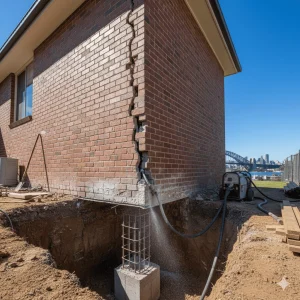
A support point moves load from the footing to competent ground. Engineers set spacing by calculating the house loads, soil reaction and the stiffness of existing foundations.
Total units are driven by measured settlement, wall layout and the performance target the engineer sets. If problems cluster, we concentrate supports rather than spread them evenly.
When unit pricing applies vs continuous or lump-sum
- Unit pricing suits discrete solutions like screw piles or resin ports aligned to load paths.
- Per-metre approaches suit continuous beam or strip upgrades along long footings.
- Lump-sum quotes fit complex scopes that include reinstatement and certification as one package.
We review access, façade sensitivity and internal finishes to choose the pricing model that protects your structure and avoids unnecessary work. For a clear, council-compliant quote see our services at Sydney Underpinning.
| Pricing Model | Typical Use | Best for | Outcome |
|---|---|---|---|
| Unit rate | Discrete supports (screw/resin) | Targeted settlement repair | Minimal disruption, measured uplift |
| Per-metre | Continuous beam/strip works | Long footings with uniform issues | Even load distribution |
| Lump-sum | Complex, multi-element projects | Full reinstatement & certification | Single fixed-price package |
Underpinning cost per pier: what to expect today in Australia
Recent market reviews show that single-unit pricing varies widely with method and site access. National guides place many jobs between $5,000 and $25,000, and some larger projects reach $35,000+.
Smaller scopes often sit in the $3,000–$15,000 band. NSW and metro Sydney trend higher because labour and tight access raise prices.
Typical ranges and why they change
Method, depth to competent ground and soil behaviour drive most variations. Resin and grout injection tend to reduce labour and excavation, lowering the unit charge.
- Traditional mass or beam work needs staged excavation. That increases time and reinstatement needs.
- Screw piles include steel supply, torque testing and verification allowances.
- Per‑metre guide rates in NSW commonly sit at $1,200–$1,500 for traditional methods.
Turning whole‑job estimates into single‑unit ballparks
Whole‑of‑job totals convert to unit figures once an engineer sets spacing and count for your foundation. We provide transparent, fixed‑price quotes with a clear pier schedule.
We explain inclusions and exclusions. That way you know what the pricing covers and what depends on site findings.
| Method | Typical range | Key driver |
|---|---|---|
| Resin/grout | $200–$300/m² | Less excavation |
| Screw piles | $250–$500/m² | Steel & testing |
| Beam & base | $180–$350/m² | Staging & reinstatement |
Key factors that influence underpinning costs
What we find on site shapes the method, duration and materials needed to restore your foundation. We assess each factor to give a clear, council‑compliant scope and engineered outcome.
Soil type, depth to competent ground and moisture conditions
Clay‑rich soil and seasonal moisture change drive movement. Soil type and moisture condition influence method selection and expected work.
Deeper targets mean more steel or resin and extra testing. That raises time and testing allowances.
Extent of structural damage and target lift
The level of damage sets the lift target and monitoring needed. Larger lifts need staged work and frequent checks to protect finishes.
Access constraints, services and safety controls
Tight access limits plant choice and extends labour. Hidden services demand location, protection and safety permits before we start.
Foundation type: slab, strip footing or deep footing
Slab edges, strip footings and deep footings behave differently. We match solutions to the actual condition of your foundations, not generic allowances.
- Engineering reports typically add $500–$3,000.
- Soil testing commonly adds $1,000–$3,000.
- Site prep and excavation can add $1,000–$5,000; utilities and reinstatement range by finish type.
We prioritise safety, structural integrity and compliant certification. We quantify risk items up‑front so you know potential variations before work begins.
Method-by-method pricing dynamics: concrete, resin and screw piles
Choosing the right method changes the schedule, disruption and budget for your foundation repair. We assess soil, access and finish sensitivity before we recommend a solution. That keeps outcomes predictable and avoids unnecessary work.
Concrete methods: mass, beam and base
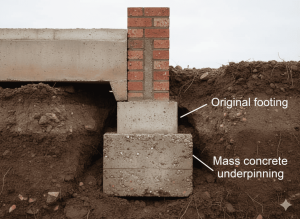
Concrete solutions need staged excavation, careful sequencing and more labour. That increases time on site and reinstatement of paths and gardens.
Guide ranges for mass or pit work are typically $150–$300/m² and beam and base $180–$350/m². Reinstatement of finishes often adds to the final invoice.
Resin injection: low disruption, fast cure
Resin fills voids and densifies soil with minimal digging. Chemical cures in minutes, so the process is fast and less disruptive to the home.
Typical guide figures sit around $200–$300/m². We favour this where access is tight and finishes matter.
Screw piling: steel, torque and testing
Screw piles include steel supply, galvanising and torque verification. Each pile requires load testing and engineering checks.
Guide rates commonly range $250–$500/m². We account for steel length and testing allowances in our quote.
- Concrete involves staged excavation and labour that raises time and expense.
- Beam and base redistributes loads and needs reinstatement of gardens and paths.
- Resin is faster, less invasive and often more cost‑efficient for localised repairs.
- Screw piling includes steel, torque criteria and testing allowances for verification.
| Method | Typical guide range | Main trade‑off |
|---|---|---|
| Mass / beam & base | $150–$350/m² | Higher disruption, robust long‑term fix |
| Resin injection | $200–$300/m² | Low disruption, fast return to use |
| Screw piling | $250–$500/m² | Steel & testing overheads, simple access |
We select the process based on engineering objectives, soil response and how sensitive finishes are around the foundation. Our quotes list repairs and allowances so you avoid surprises.
How much underpinning costs across Australian states
Where your house sits often dictates the likely range for a foundation repair budget. State differences in labour, regulation and logistics create clear pricing bands.
Why NSW and metro Sydney often price at the higher end
Labour rates, tighter access and strict council rules push Sydney pricing higher than many other states. Denser suburbs mean more time on site and more care to protect finishes.
Local labour rates, council compliance and site logistics
Soil profiles vary across regions. Reactive clays or deeper competent strata increase design conservatism and material needs.
- State‑to‑state differences reflect labour, regulations and transport logistics.
- Greater Sydney often sits at the top due to access limits and inspection requirements.
- We adapt scopes for terraces, narrow lots and shared driveways to reduce disruption.
| State / Area | Typical guide range | Main drivers |
|---|---|---|
| NSW (Metro Sydney) | $1,200–$1,500/m; $25k–$60k project | High labour, compliance, tight access |
| Other mainland states | Lower median ranges; varies by regional supply | Lower labour rates, easier logistics |
| Regional & rural areas | Variable; materials & travel add to time | Transport costs, longer site programmes |
We specialise in Sydney delivery and council requirements. We are fully licensed and insured, and we explain regional drivers clearly in every quote. That helps you understand why local pricing differs and what protects your foundation and house finishes.
When underpinning is required: signs, risks and timing
Small changes around your home can signal bigger foundation problems ahead.
Look for stepped or widening cracks, doors and windows that stick, and floors out of level. New or rapidly changing cracks suggest active movement and need prompt assessment.
Moisture near footings speeds up movement. Improving drainage and subfloor ventilation can slow deterioration and reduce future damage.
- Early intervention reduces expense and protects finishes.
- Untreated movement can move from cosmetic damage to serious structural issues.
- We inspect foundations, external walls and internal linings to confirm whether underpinning is required.
- We advise when monitoring is safe versus when immediate works are needed.
- We offer wall crack repairs and ventilation strategies to stabilise conditions.
| Sign | Risk | Recommended action |
|---|---|---|
| Stepped or widening cracks | Active movement, expanding damage | Engineer inspection and monitoring |
| Doors and windows sticking | Distortion of frames | Assess frame alignment; consider targeted repairs |
| Persistent moisture at footings | Accelerated movement and decay | Improve drainage and subfloor ventilation |
We prioritise safety and clear advice. If you notice these issues, contact us for a calm, prompt assessment so you can protect your home and avoid further damage.
What a professional, council‑compliant quote should include
A professional quote is a documented roadmap that protects your building and your budget. It starts with a clear inspection and delivers written details you can rely on.
Free no‑obligation structural assessment and clear scope
We begin with a free, no‑obligation inspection to confirm whether work is needed. The inspection report explains what we saw and the recommended scope in plain language.
Fixed‑price breakdown, inclusions, exclusions and allowances
Our fixed‑price quote lists inclusions, exclusions and allowances so you know what influences final sums. We state typical ancillary items, such as structural engineer fees ($500–$3,000) and soil testing ($1,000–$3,000).
Engineering report coordination, soil testing and certification
We coordinate a structural engineer and geotechnical testing when required. Certification, drawings and pier layouts come with the documentation to meet council requirements and building approval.
- Your quote begins with a free inspection and a written scope that is easy to follow.
- Fixed‑price breakdowns list inclusions, exclusions and allowances so you understand all costs.
- We coordinate a structural engineer and geotechnical testing when conditions warrant it.
- We explain the process step by step, including safety controls, monitoring and certification.
- Our documentation includes drawings, layouts and specifications aligned to your building.
- We define reinstatement inclusions so you avoid surprises about finishes.
- We set a clear programme with milestones, access windows and neighbour considerations.
- Warranties, insurances and council‑compliant certification are included for your records.
| Item | Typical range | Purpose |
|---|---|---|
| Structural engineer report | $500–$3,000 | Design verification and certification |
| Soil / geotech testing | $1,000–$3,000 | Determine ground targets and method |
| Fixed‑price inclusions | Quoted in document | Scope, safety, reinstatement and certification |
Total cost of ownership: disruption, reinstatement and peace of mind
Long-term value from a foundation repair goes well beyond the initial invoice. We look at time on site, the repairs needed to finishes, and the paperwork that protects your property value.
Minimising time out of the home and protecting finishes
We plan works to limit disruption and keep you in your home wherever safe and practical. Resin-based solutions often reduce time on site and protect internal finishes compared with heavy excavation.
Our programme includes dust control, protection of paths and gardens and careful reinstatement planning. We factor likely post-works replastering and painting into scopes. Replastering and painting can add $1,000–$5,000. Flooring reinstatement typically sits at $2,000–$8,000 depending on material and area affected.
Warranties, insurances and engineer certification give long-term confidence in the structure. We provide as-built records, test results and clear scopes to support future sale and due diligence.
- We plan works to limit disruption and keep you in your home wherever safe.
- Resin-based solutions reduce time on site and protect internal finishes.
- Our programme includes dust control and careful reinstatement planning.
- Warranties, insurance and certification provide lasting peace of mind.
| Reinstatement item | Typical range | Why it matters |
|---|---|---|
| Replaster & paint | $1,000–$5,000 | Restores internal finishes and resale appeal |
| Flooring reinstatement | $2,000–$8,000 | Material choice affects time and price |
| Documentation & testing | $500–$3,000 | Supports compliance and buyer confidence |
Our experience coordinates trades and services efficiently. We factor likely repairs into quotes so you see realistic totals and avoid surprises. Durable stability and clear paperwork deliver lasting protection for your home and its value.
Insurance and underpinning: what’s usually covered
Insurance rules often draw a clear line between sudden events and gradual movement when it comes to foundation cover.
Policies may respond to sudden damage from flooding or earthquakes. They commonly exclude subsidence from ongoing soil shrinkage or tree roots. Many insurers view stabilising work as preventative and deny claims.
We provide practical help. We supply photos, engineer reports and formatted evidence to support any insurer discussion. We also separate insured repairs from owner‑funded stabilisation so you see true costs clearly.
- Insurers often exclude gradual soil movement and root damage.
- Sudden events like floods may be considered differently by some policies.
- Clear paperwork speeds claims and reduces dispute time.
| Insurer stance | Typical cover | Homeowner action |
|---|---|---|
| Sudden event | Possible cover for repair works | Notify insurer; supply reports and photos |
| Gradual movement | Usually excluded | Budget owner-funded stabilisation |
| Prevention work | Not covered | Ask for separate engineer scope and quote |
Getting an accurate underpinning cost per pier for your house
A quick photo review can narrow options, but a site visit confirms precise measures.
On‑site inspection vs photo review: what we can price remotely
Send clear photos and we will give a fast preliminary assessment. We confirm likely methods and an indicative range before visiting.
Remote review flags obvious cracks, drainage issues and access limits. It helps us advise likely soil response and foundation risk.
An on‑site inspection verifies levels, plumbing, hidden damage and safe access. That visit refines the quote and the documented scope.
How we determine pier spacing, load and resin/steel quantities
Engineering sets spacing from load paths, soil tests and target lift. We use measured loads and ground response to size each support.
Resin volumes or steel lengths are estimated from depth to competent ground and design criteria. Foundations and finishes then guide drill locations and staging.
- Send photos for a fast preliminary view and indicative methods.
- An on‑site inspection verifies levels, cracks, plumbing and access to refine figures.
- Engineers determine spacing from load, soil response and lift targets.
- We estimate resin volumes or steel lengths from depth to competent ground.
- We document the underpinning process, from testing to monitoring, so expectations are clear.
- Our quote aligns unit count to observed conditions and access limits to fix the final total.
We encourage emailing photos for a preliminary assessment and booking a site inspection for firm pricing. We book quickly and keep communication clear so decisions are simple and timely.
Why choose Underpinning Sydney for foundation repair
You need clear answers, honest advice and a team that knows Sydney soils and council rules.
20+ years’ experience, licensed & insured, honest assessments
We bring over 20 years’ experience stabilising Sydney homes with council‑compliant engineering. Our team is fully licensed and insured so you have documented protection and warranty support.
We give straightforward assessments. We tell you when repairs are needed and when monitoring is enough. There is no upselling — only practical advice and a clear scope.
Minimal disruption methods and Sydney‑specific engineering
We match methods to tight access, heritage building needs and local soils. That keeps disruption low and finishes intact.
Our services include concrete beam work, resin injection and screw systems. We also manage wall crack repairs, subfloor ventilation, retaining wall support and engineering reports.
Speak to Chris — book a site inspection or email photos
Call 1300 970 930 to speak to Chris. Book a site inspection or email photos for a fast preliminary view.
We keep you informed at every step. We finish with a clean, safe site and full certification for the structure and your records.
- Local experience and tailored methods for Sydney homes.
- Licensed trades, engineer coordination and compliant documentation.
- Honest, fixed‑price quotes with defined inclusions and warranties.
| Feature | What we deliver | Benefit to you |
|---|---|---|
| Experience & licences | 20+ years; insured trades; engineer coordination | Reliable work and council‑compliant certification |
| Methods & services | Concrete, resin, screw systems; crack repairs; ventilation | Minimal disruption; tailored foundation repair |
| Service promise | Honest assessment; fixed quotes; clean site | Clear expectations and peace of mind |
Conclusion
Prompt assessment turns guesswork into a defined plan with measurable outcomes.
Underpinning is a precise engineering process that restores foundation stability and protects your house from further structural damage.
Costs vary by method, soil type, access and the extent of structural damage. A professional inspection refines numbers and sets spacing, materials and the repair scope.
Concrete solutions suit many projects. Resin and screw systems cut disruption and speed return to use. Our structural engineer coordinates the process and issues the required certification.
Visible cracks, sticking windows or uneven floors need prompt review. Delaying work can raise structural damage and overall costs.
Call 1300 970 930 to speak to Chris, book an inspection or email photos to start a clear, fixed‑price quote for your foundation repair today.