
If you’re comparing resin injection vs concrete underpinning to fix a shifting foundation, you need clear facts fast. We explain the difference and show which method suits Sydney soils and your budget.
We are Underpinning Sydney, structural preservation specialists with over 20 years’ experience. We are fully licensed, insured and use council‑compliant methods that meet AS2870. Our team gives honest assessments and avoids upselling.
Typical concrete works require excavation and can take days to weeks, while engineered expanding polymers often finish in one to two days with minimal mess. Costs and disruption vary by ground conditions, so we coordinate reports and fixed‑price quotes to keep things simple.
Start with a free, no‑obligation structural assessment. Call 1300 970 930 and speak to Chris, or email photos for a preliminary view before booking a site inspection.
Key Takeaways
- We compare the two main methods so you can choose a safe, compliant fix.
- Our team has 20+ years’ experience with Sydney soils and structures.
- One option can be quick with minimal mess; the other is more disruptive but traditional.
- We provide free assessments, fixed‑price quotes and engineering coordination.
- Safety and AS2870 compliance protect your home and resale value.
Foundation warning signs in Sydney and why prompt, compliant underpinning matters
Early warning signs in walls and floors are a homeowner’s best chance to act. Look for cracks walls near windows and doors, floors that slope and doors or windows that stick. These signs often signal subsidence or movement in the existing foundation.
In Sydney, reactive clay and changing soil moisture drive much of the movement. Tree roots, poor drainage and leaking services let water travel and undermine the ground under footings. Left unchecked, small cracks become structural damage and can affect other buildings nearby.

Acting early reduces scope and cost. We assess soil, drainage and structural issues so the solution treats the cause, not just the symptoms. Compliant works follow AS2870 to avoid differential movement on clay sites.
- Look for cracks, sticking frames and uneven floors.
- Fix drainage and moisture sources before works begin.
- We offer a free, no‑obligation assessment and honest advice.
Call 1300 970 930 to speak to Chris or email photos for a preliminary view. We explain options simply and provide transparent, fixed‑price quotes for safe, compliant underpinning.
Resin injection vs concrete underpinning: method, time, cost and compliance compared
We set out how small‑hole, high‑precision lifting compares to excavated mass concrete so you know what to expect on site.
How each method works
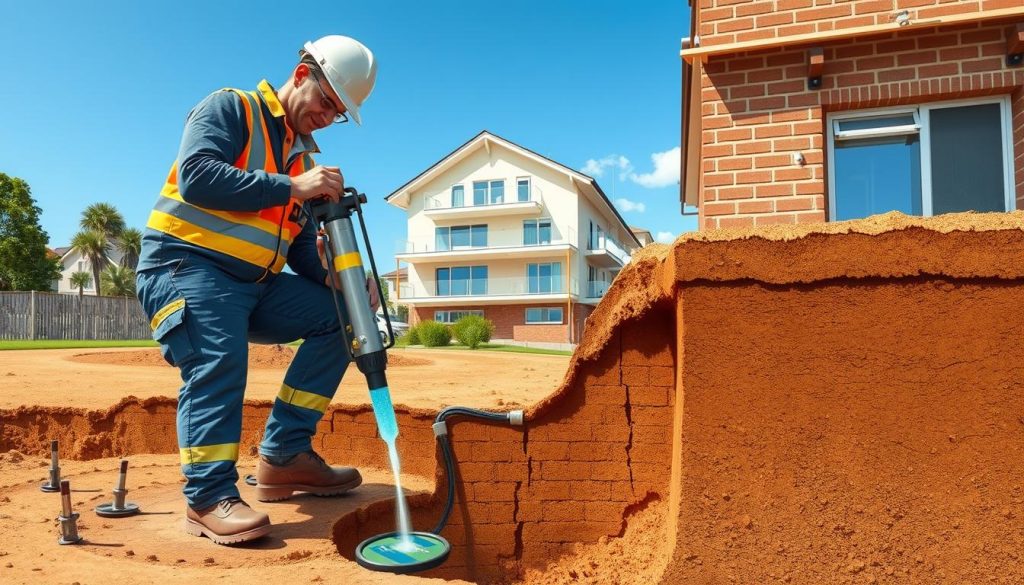
Small‑hole injection underpinning drills discreet holes and injects an expanding polymer that compacts soil and fills voids. Technicians use laser levelling to control staged lifts and protect finishes.
Excavated mass concrete involves staged digs beneath the existing footing, forming and pouring concrete beams or pads. It requires cure time before load transfer.
Time, disruption and soil suitability
Small‑hole projects commonly finish in one to two days with minimal noise. You often remain in your home during works.
Excavated works can run days to weeks. They create spoil, noise and access limits. On reactive clay soils, staged partial pours may risk differential movement under AS2870 if not designed correctly.
Cost, footprint and precision
Guideline costs: mass concrete from about $1,000–$3,000 per metre; beam and base higher; many small‑hole projects fall between $4,000–$15,000 depending on scope and access.
Environmental and reinstatement costs tend to be lower with small holes. Excavation produces spoil, dust and reinstatement labour.
| Feature | Small‑hole method | Excavated method |
|---|---|---|
| Typical duration | 1–2 days | Days to weeks |
| Site spoil | Minimal | High (trenches, waste) |
| Precision control | Laser levelling, staged lifts | Depends on staged pours and engineers’ checks |
- We match the method to site testing and AS2870 compliance.
- We provide fixed‑price quotes, engineering reports and documented outcomes.
When to choose resin, when to choose concrete underpinning, and where screw piling fits
The best solution for a moving foundation depends on ground conditions, the area affected and your occupancy needs.
Resin injection underpinning is clean and fast. We recommend it where reactive clay soils and moisture swings cause movement. It suits tight access and internal areas. You can often remain in your home during works.
When mass concrete is right
Concrete underpinning is practical for small, heavy sections or where a local mass unit is the correct load solution. It is slower and more disruptive. On reactive clay, staged partial pours must be engineered to meet AS2870 to avoid differential movement.
Screw piling and deeper options
Screw piles extend support to deeper competent layers when near‑surface soils are weak or variable. They bypass poor ground beneath shallow footings and suit sites needing greater depth or capacity.
- Choose injection underpinning for reactive clays and minimal disruption.
- Pick concrete underpinning for specific small areas or heavy loads.
- Use screw piling where deeper strata are required or soils vary.
- Combine moisture control and drainage on clay sites to reduce future movement.
| Issue | Best method | Key benefit |
|---|---|---|
| Reactive clay, internal access | Resin injection underpinning | Fast, low reinstatement, controlled lift |
| Small heavy area or local footings | Concrete underpinning | Mass capacity, proven traditional method |
| Very weak or variable soils | Screw piling | Transfers load to deeper competent strata |
We recommend the right method without upselling. Our engineers match soil testing, structure and access, then document the design for compliance. For a free assessment, call 1300 970 930 or book a review at Underpinning Sydney.
Our engineering-led process: honest assessment, compliant methods and documentation
We lead every job with a clear engineering process so you know what will happen on site and when. Our goal is to protect your foundation, limit disruption and leave a full record for council and resale purposes.
Free structural assessment and photo review
Start with a no‑obligation assessment. Email photos for a quick preliminary view or book a site visit. We review your photos, note visible cracks and outline likely works before any quote.
On‑site testing and laser monitoring
On site, underpinning involves testing soil and monitoring movement. We use laser levelling to set safe lift limits and protect nearby buildings and walls.
Transparent quotes, council compliance and certification
We provide fixed‑price quotes that detail scope, labour, programme and reinstatement. Methods are council‑compliant and backed by engineering reports and certificates.
Minimising disruption and coordinating repairs
Many projects let homeowners stay in their home. Where more access is needed we manage spoil, safety and noise. We also coordinate crack repairs, subfloor ventilation and retaining wall support.
| Stage | What we do | Benefit |
|---|---|---|
| Assessment | Photo review + site testing | Faster, tailored quote |
| Monitoring | Laser data + engineer checks | Controlled lift, less risk |
| Completion | Reports + certification | Council‑ready documentation |
Call 1300 970 930 and speak to Chris to arrange your free assessment and lock in a site visit.
Conclusion
A clear, engineered fix brings foundations back to safe, long‑term performance.
Fast, laser‑controlled resin injection underpinning often gives a clean stabilisation in one to two days. Traditional concrete underpinning still has a place for specific local needs but is slower and more disruptive. Both must match soil behaviour to avoid new cracks or subsidence.
We are licensed, insured and council‑compliant. We give honest assessments, fixed pricing and full certification. Email photos for a quick preliminary view or book a site inspection.
Call 1300 970 930 and speak to Chris to secure your foundation and protect your property value.