
We stabilise homes and protect structures with engineered solutions you can trust. Call 1300 970 930 to speak to Chris for a no‑obligation assessment and a fixed‑price quote.
We are Underpinning Sydney. With 20+ years’ experience we deliver council‑compliant underpinning and ground stabilisation for residential projects.
Our process uses proven permeation methods and concrete underpinning where needed to strengthen footings and reduce movement. We design targeted ground treatment, coordinate engineering reports and follow Australian Standards.
We give honest assessments and avoid upselling. Expect clear scope, licensed workmanship and minimal disruption. For void filling or related ground work see our detailed service page at void filling services. Call 1300 970 930 to book a site inspection or email photos for a preliminary assessment.
Key Takeaways
- Engineered solutions protect your home from further movement.
- We provide council‑compliant reports and fixed‑price quotes.
- Our process focuses on lasting stabilisation with minimal disruption.
- Licensed, insured teams coordinate structural engineering for each project.
- Call 1300 970 930 to speak to Chris or arrange an inspection.
Protecting Sydney homes with council‑compliant grout injection and underpinning
We provide council‑compliant underpinning and low‑pressure ground solutions that protect homes from ongoing movement.
Calm, engineering‑led assessments for structural integrity and safety
We inspect movement, cracking and moisture to identify the root cause of settlement and subsidence. Our engineers analyse wall cracks, footing behaviour, drainage and nearby loads.
You get a clear scope, drawings if required, and a fixed price. We liaise with your council and coordinate structural engineering reports to streamline approvals.
Call 1300 970 930 to speak with Chris or email photos for a preliminary assessment
Permeation methods strengthen granular soil via low‑pressure cement that forms designed wedges. Grout piles underpin in sandy ground where augers cannot hold. Slabjacking lifts and relevels concrete slabs while filling voids neatly.
- Targeted low‑pressure sequences minimise excavation and mess.
- Tidy access, careful drilling and reinstatement protect gardens and finishes.
- We set realistic timelines so you know what will happen and when.
| Service | Outcome | Typical time |
|---|---|---|
| Engineering assessment | Clear diagnosis of movement and required work | 1–3 days |
| Low‑pressure ground work | Increased bearing and arrested settlement | 1–5 days |
| Slabjacking & void filling | Lifted slabs and restored serviceability | 1–2 days |
| Council coordination & reports | Compliant approvals and certified outcomes | Varies by council |
Call 1300 970 930 to speak to Chris now or email photos for a quick preliminary opinion. We focus on safety, certification and permanent outcomes with no upsells.
Grout Injection Foundations Sydney — What it is and when it’s right
Permeation techniques let us strengthen weak granular soils without major excavation.
Permeation grouting is a low‑pressure method that fills the gaps between particles. We use microfine and ultrafine cement systems to reduce permeability and raise bearing capacity.
Permeation grouting: improving granular soils
This approach forces fine cement pastes into sand and similar soils. Single spears are set at angles to form engineered wedges or blocks. Low pressure lowers the risk of ground heave and protects nearby services.
Microfine and ultrafine cement: materials and process
Ultrafine inorganic cementitious materials penetrate tight sands and set in 4–8 hours. We model site conditions first and select the right mix so results are durable and predictable.
Where this method excels
- Sand and loose soils: stabilises bearing and limits water flow.
- Voids and rock fissures: fills cavities and seals joints.
- Retaining walls and slabs: improves support and reduces seepage along wall lines.
We document every stage to satisfy council and lender requirements and choose the method that matches your property and budget. For differences with other structural work see underpinning vs restumping.
Our council‑compliant process: minimal excavation, maximum stability
We use careful, council‑compliant steps to stabilise ground with minimal disruption. Our goal is clear: durable support, tidy sites and full certification so you have peace of mind.
Engineering investigation
We begin with a focused inspection of settlement, subsidence, wall cracking and water pathways. Bore logs, moisture readings and site history inform the right scope and the most suitable method.
Low‑pressure strategy
We place stainless‑steel spears at single and multiple angles to form controlled blocks or wedges in the soil. Ultrafine cementitious materials allow precise penetration and reliable set times.
Quality controls and certification
Licensed and insured teams track volumes, pressures and set profiles for full transparency. We coordinate structural engineering reports and deliver compliant documentation for council and lenders.
Site care and disruption control
Access is tidy, drilling is targeted and excavation is minimised to protect gardens and services. Slabjacking uses small‑diameter holes to fill voids, lift concrete and reinstate neat cores for a clean finish.
You get a fixed price and an honest scope so the work is predictable from assessment to certification.
Where we apply grout injection across Sydney structures and soils
From coastal sand to reclaimed land, we deliver targeted work that stabilises load paths and halts further settlement.
Underpinning and stabilisation
Footings and load support
We arrest footing movement and restore bearing capacity beneath footings and slabs. This protects load‑bearing walls and columns and reduces further cracking.
Void filling and water control
Sealing cavities and seepage barriers
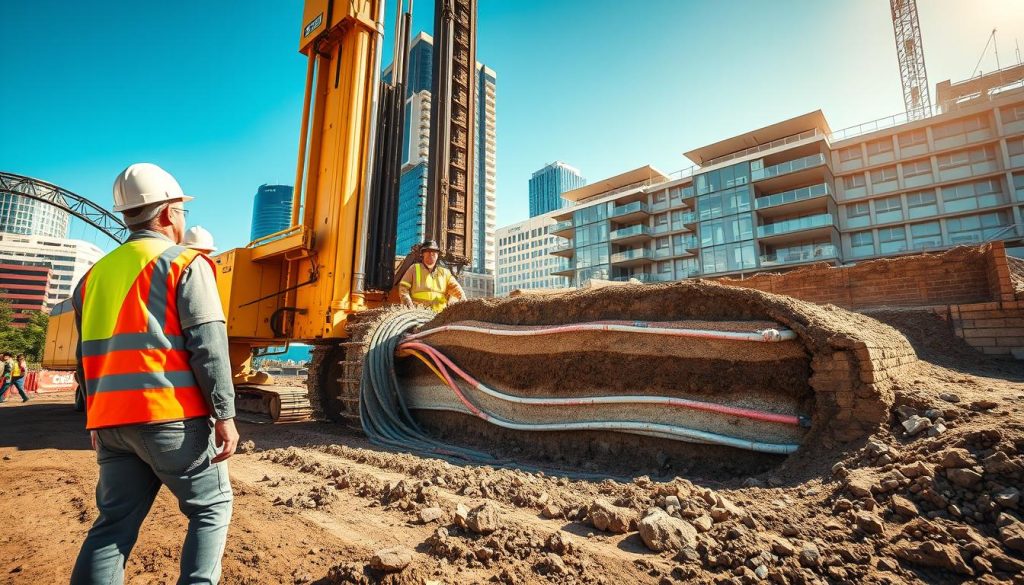
We fill voids and fissures behind walls and in rock to stop loss of support. Curtain treatments create seepage barriers to control water and protect interiors.
Support and preparation for works
We stabilise backfill to lower collapse risk and improve subgrade before extensions or heavy loads. Cementitious slabjacking lifts sunken concrete with neat core reinstatement.
- Footing underpinning to restore capacity in sandy ground
- Stabilisation beneath walls to protect finishes and services
- Void filling to prevent loss of support
- Seepage barriers to control water ingress
- Retaining walls support and subgrade preparation
- Slabjacking for driveways, paths and internal slabs
We document every stage and provide compliant reports for council, insurance and future building projects.
Choosing the right method: grout injection, concrete underpinning, resin injection and screw piling
Selecting the right stabilisation route depends on your site’s soil type and structural needs. We start with a clear geotechnical review to match the work to risk, access and long‑term performance.
Grout piles and permeation grouting vs screw piling in granular soils
In loose sands, grout piles or permeation grouting often outperform screw piling. They form designed blocks that improve bearing and control settlement without heavy excavation.
When concrete underpinning is preferred for foundations and walls
Concrete underpinning suits moderate depths and tight wall geometry. It is straightforward to certify and gives predictable load capacity when access allows piering.
Why we avoid polyurethane resins
Polyurethane resins can migrate through soils and services and contain reactive chemicals. We favour cementitious systems for predictable behaviour, environmental handling and council compliance.
- Clear comparisons: we choose by geotech profile and lifecycle costs.
- Least disruption: we target improvement for the lowest sensible cost.
- Transparent advice: you get compliant scopes and durable outcomes, not upsells.
Pricing clarity, timelines and guarantees for Sydney projects
We give upfront costs and realistic schedules so you can plan with confidence.
Transparent fixed‑price quotes and honest assessments
Start with a free, no‑obligation assessment. We outline scope, inclusions and exclusions so you know exactly what the costs cover.
We coordinate engineering reports and council paperwork as part of the quote. That means fewer surprises and no upsells.
Typical time on site and curing windows for cementitious work
On‑site durations are kept short and staged to reduce noise and disruption. Typical projects are planned to fit your schedule.
Ultrafine cement systems commonly reach initial set in 4–8 hours, enabling staged load transfer and timely re‑occupation. Slabjacking uses small drilled holes to fill voids, lift slabs, clean cores and reinstate neat finishes.
- Fixed‑price quotes with clear inclusions.
- Minimal excavation and protected finishes throughout the works.
- All work documented for council, insurers and future building needs.
- Workmanship insured and backed by engineered guarantees.
We stand behind our engineered solutions. Call 1300 970 930 to speak with Chris or book a site inspection today. For more on timing see our detailed guide on how long underpinning takes: project timelines and expectations.
Conclusion
Conclusion
We restore structural safety and long‑term value by treating the ground beneath affected homes. Our engineered, low‑pressure process strengthens loose soil and limits further settlement.
You receive licensed, insured workmanship backed by structural engineering and clear certification. We favour cementitious systems and neat slabjacking to lift sunken concrete and reinstate finishes with minimal excavation and tidy site care.
For trusted underpinning advice, call 1300 970 930 to speak with Chris or email photos to begin a no‑obligation assessment.